
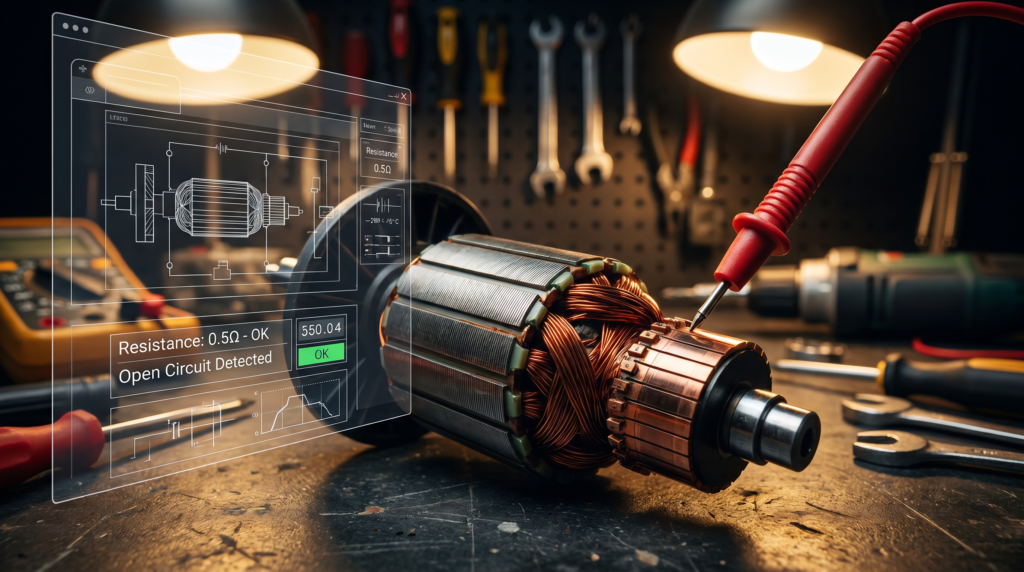
Complete Guide to Power Tool Motor Repair
When a power tool stops working, the motor is usually the culprit. Understanding power tool motor repair at the component level is essential for any technician, repair shop owner, or DIY enthusiast. This guide covers everything from diagnosing common motor failures to sourcing quality replacement parts and completing the repair.
How Universal Motors Work in Power Tools
Most handheld power tools — angle grinders, circular saws, demolition hammers, and rotary hammers — use universal motors. These motors run on both AC and DC current and consist of two main components:
- Armature (rotor): The rotating part that converts electrical energy into mechanical motion. It sits inside the stator and is connected to the output shaft via bearings.
- Stator (field): The stationary electromagnetic coils that create the magnetic field needed to spin the armature.
When either component fails, the motor stops working or performs poorly. A solid understanding of power tool motor repair means knowing which component failed and how to replace it efficiently.
Common Power Tool Motor Failures
| Symptom | Likely Cause | Repair |
|---|---|---|
| No power, no sound at all | Open circuit in stator or armature | Test winding continuity, replace faulty component |
| Motor runs but lacks torque | Shorted stator windings, worn brushes | Replace stator, replace carbon brushes |
| Excessive sparking at brushes | Worn commutator, shorted armature coil | Replace armature |
| Overheating rapidly | Shorted windings, voltage mismatch | Replace stator or armature |
| Loud humming, won’t spin | Seized bearings, locked rotor | Replace bearings, inspect rotor |
Diagnosing Motor Problems: Step by Step
1. Visual Inspection
Open the tool housing and examine the motor. Look for charred winding insulation, broken wires, burned commutator bars, or excessive carbon dust buildup inside the housing.
2. Brush Check
Remove the brush caps and inspect the carbon brushes. Brushes shorter than 1/4 inch should be replaced. If the brush spring is broken or weak, replace the brush assembly. Stuck brushes are a common cause of intermittent motor operation.
3. Armature Test (Continuity & Insulation)
Using a multimeter set to resistance mode:
- Test between adjacent commutator bars — each pair should read the same resistance
- Test between commutator and armature shaft — reading should be infinite (OL), indicating no short to ground
- A reading of zero between any bars indicates a shorted winding
4. Stator Test
Measure resistance across the two stator terminal wires. Compare with the manufacturer’s specification. If the reading is zero (short) or infinite (open), the stator has failed. Also test from each terminal to the stator core — any reading under several megaohms indicates insulation breakdown.
5. Bearing Check
Spin the armature shaft by hand. Rough or gritty rotation indicates bearing failure. Worn bearings cause vibration, noise, and eventual rotor damage.
Step-by-Step Motor Repair Process
Replacing an Armature
- Disconnect power and open the tool housing
- Remove brush assembly and brush plate
- Slide the old armature out of the stator bore
- Check the stator bore for debris, rust, or damage
- Install the new armature, ensuring bearings seat properly
- Reassemble brush gear and test spin by hand
- Close housing, test tool under power
Replacing a Stator
- Take a photo of wire connections before desoldering
- Desolder stator wire connections
- Remove stator mounting screws
- Slide out the old stator
- Install new stator with proper orientation
- Secure mounting screws and re-solder wires
- Verify orientation matches original before full reassembly
- Test at low speed before heavy use
Where to Source Quality Motor Repair Components
Using cheap, substandard replacement parts is the number one cause of repair comebacks. Always source OEM-compatible armatures and stators from a trusted manufacturer. Prime Armature supplies precision-wound armatures and stators for all major power tool brands including Bosch, Makita, DeWalt, Hitachi, Skil, and Dongcheng. Every component is:
- Manufactured to original equipment tolerances
- Wound with high-grade copper wire
- Precision-balanced for smooth operation
- Tested before shipping
When to Recommend Replacement vs. Repair
Not every tool is worth repairing. A clear policy helps customers trust your recommendations:
- Budget tools under $100: Generally not cost-effective to repair — replacement is cheaper
- Mid-range tools $100-$300: Worth repairing when the motor is the problem and quality parts are used
- Professional tools $300+: Almost always worth repairing with original-spec components
Global Shipping to India, Middle East & Asia
Prime Armature serves power tool repair professionals and distributors worldwide. Our key markets include:
- India — Delhi, Mumbai, Bangalore, Chennai, Hyderabad, Ahmedabad, Pune, Kolkata, Surat, Jaipur, Lucknow, Kanpur, Nagpur, Indore, Thane, Bhopal, Visakhapatnam, Patna, Vadodara, Coimbatore
- Middle East (KSA, UAE, GCC) — Riyadh, Jeddah, Dammam, Dubai, Abu Dhabi, Sharjah, Doha, Kuwait City, Muscat, Manama
- South Asia — Pakistan (Karachi, Lahore), Bangladesh (Dhaka), Sri Lanka (Colombo), Nepal (Kathmandu)
- East & Southeast Asia — Indonesia (Jakarta), Philippines (Manila), Vietnam (Ho Chi Minh City), Thailand (Bangkok), Malaysia (Kuala Lumpur), Singapore
We offer flexible shipping options including air freight for urgent orders (3-7 days) and sea freight for bulk shipments (15-30 days). Customs documentation and duties guidance available for all markets.
Frequently Asked Questions
Can I replace just the brushes instead of the whole motor?
Yes. If the motor runs but has excessive sparking or intermittent operation, new brushes may solve the problem. Always inspect the commutator surface — if it’s badly pitted or grooved, the armature should also be replaced.
How do I know if the armature or stator is bad?
Use a multimeter. Test armature commutator bars for continuity and shorts to ground. Test stator windings for correct resistance and insulation breakdown. If both test good, the problem may be the switch, cord, or brushes.
Is it better to rewind or replace a motor?
For repair shops, replacement is almost always faster and more cost-effective. Rewinding requires specialized equipment and expertise that most shops don’t have in-house. A factory-grade replacement armature or stator ensures consistent performance.
Where can I buy armatures and stators in bulk?
Prime Armature supplies wholesale quantities of armatures and stators for power tool distributors and repair chains worldwide. Contact us for pricing, minimum order quantities, and shipping to your region.
Final Thoughts on Power Tool Motor Repair
Mastering power tool motor repair is a valuable skill that builds customer trust and repeat business. Use quality components, test thoroughly, and always communicate clearly with your customers about repair vs. replacement options. Prime Armature is your partner for reliable, OEM-spec armatures and stators.