
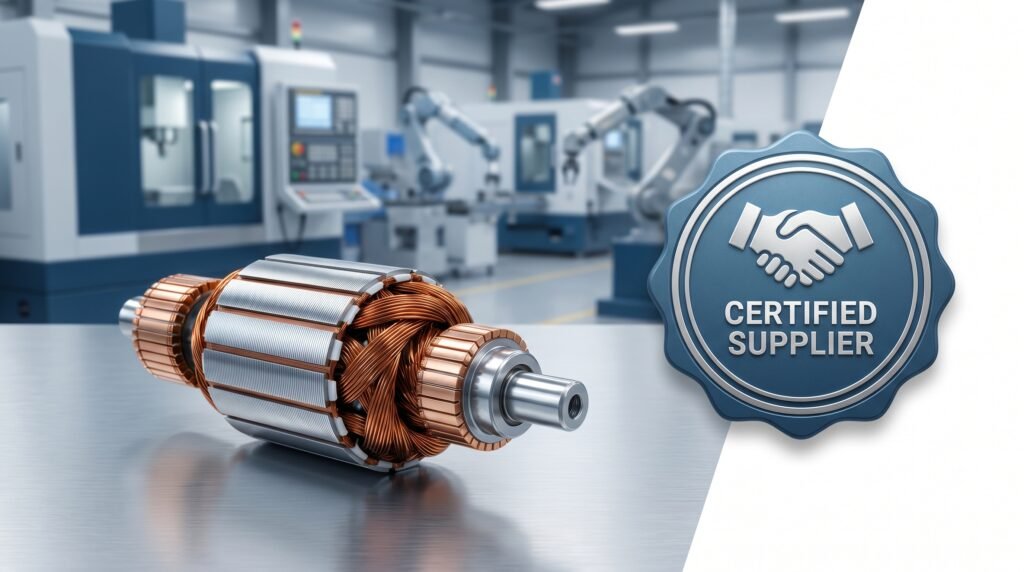
Whether you run a power tool repair shop, distribute spare parts, or manufacture equipment, the armature supplier you choose directly impacts your business. A bad armature means returns, complaints, and lost customers. A good one keeps your tools running and your reputation solid.
This guide covers exactly what to look for in an armature supplier, how to evaluate quality, what pricing to expect, and how Prime Armature delivers on every front.
What Does an Armature Supplier Provide?
An armature supplier manufactures and distributes the rotating electromagnetic component found inside power tool motors. Armatures work together with stators to convert electrical energy into mechanical motion — the torque and speed that drive angle grinders, demolition hammers, rotary hammers, circular saws, and drills.
A full-service armature supplier typically offers:
- OEM replacement armatures — drop-in compatible parts for Bosch, DeWalt, Makita, Hitachi, KPT, and other major brands
- Custom armature manufacturing — made to your winding specs, shaft dimensions, and insulation class
- Bulk wholesale pricing — volume-based discounts for repair centers and distributors
- Technical support — compatibility matching and engineering guidance
Many armature suppliers also stock stators and other motor components, making them a one-stop shop for power tool spare parts.
Key Factors When Evaluating an Armature Supplier
1. Material Quality
Not all armatures are built the same. A quality armature supplier uses:
- High-grade copper windings — pure electrolytic copper (not aluminum) for maximum conductivity and heat dissipation
- Precision-balanced rotors — dynamic balancing to G2.5 or better, reducing vibration and extending bearing life
- Durable commutators — silver-bearing or copper alloy segments with proper mica undercutting
- High-temperature insulation — Class F or H insulation rated for sustained heavy-duty operation
When comparing suppliers, ask about their raw material sources and whether they perform incoming material inspection.
2. Quality Control and Testing
A reputable armature supplier tests every component before shipment. Look for:
- Dynamic balancing on all rotors
- Surge testing for winding integrity
- Insulation resistance (megger) testing
- Hi-pot (dielectric strength) testing
- Dimensional verification against OEM specs
At Prime Armature, each armature undergoes these tests as standard. Test reports are available on request for bulk orders.
3. Product Range and Compatibility
The best armature suppliers stock hundreds of models covering multiple brands. This matters because:
- Fewer suppliers to manage — one armature supplier for all your power tool needs
- Consistent quality — same manufacturing standards across all products
- Easier logistics — combine armatures and stators in a single shipment
Check whether the supplier covers your most commonly requested models before committing.
4. Armature Price vs. Value
Armature price is always a factor, but it should never be the only one.
| Factor | Low-Cost Supplier | Quality Supplier |
|---|---|---|
| Copper grade | May use recycled or aluminum | Pure electrolytic copper |
| Balancing | Skip or spot-check | 100% dynamic balanced |
| Testing | Visual only | Full electrical + mechanical |
| Failure rate | 5–10% or higher | Under 1% |
| Warranty | Limited or none | Standard replacement warranty |
A cheaper armature that fails after 50 hours of use costs more in returns, labor, and customer trust than a quality component at a fair armature price.
5. Lead Time and Shipping Reliability
For repair shops and distributors, downtime is expensive. A good armature supplier maintains:
- Standard orders — shipped within 3–7 business days
- Bulk orders — 10–15 business days depending on volume
- Express options — DHL, FedEx, or UPS for urgent needs (2–5 days)
- Tracking and insurance — on every shipment
Prime Armature ships worldwide from our manufacturing facility with full tracking and insurance on all orders.
Armature Supplier vs. Power Tool Spare Parts Distributor
While an armature supplier specializes in motor components, a power tool spare parts distributor typically stocks a broader range of parts — switches, carbon brushes, chucks, bearings, gears, and field coils.
The advantage of working with a specialized armature supplier:
- Deeper technical expertise — they understand winding configurations, insulation classes, and compatibility nuances
- Better pricing on armatures — direct from the manufacturer, no middleman markup
- Custom capabilities — they can build armatures to your exact specifications
Many businesses work with both: a dedicated armature supplier for motor parts and a general distributor for everything else.
Why Stator Quality Matters Too
Armatures and stators work as a matched pair. A poor-quality stator will degrade armature performance and vice versa. That is why a good stator manufacturer applies the same quality standards: high-grade copper windings, proper insulation, and precise dimensional tolerances.
When sourcing from an armature supplier, check whether they also manufacture stators to the same standards. Buying both from the same supplier ensures compatibility and simplifies procurement.
Industries That Rely on Quality Armature Suppliers
| Industry | Typical Usage | Common Brands |
|---|---|---|
| Power tool repair centers | Armature replacement for customer tools | Bosch, DeWalt, Makita |
| Equipment distributors | Bulk supply to aftermarket | KPT, Dongcheng, Hitachi |
| OEM manufacturers | Custom armatures for new tools | All major brands |
| Industrial maintenance | Motor rebuilds for factory equipment | AC/DC industrial motors |
| E-commerce sellers | Fulfillment of spare parts orders | Mixed models |
How to Start Working with an Armature Supplier
Ready to find your partner? Follow these steps:
Step 1: Define Your Needs
List the models, quantities, and delivery timeline you need. This helps the supplier quote accurate armature price and lead time.
Step 2: Request Samples
Before committing to volume, request samples of 3–5 models you order most frequently. Test them for fit, balance, and performance.
Step 3: Evaluate Communication
A good supplier responds within 24 hours, provides clear technical answers, and follows up proactively. Communication speed often correlates with service quality.
Step 4: Start Small
Place an initial order of 50–100 pieces to evaluate quality, packaging, and delivery before scaling up.
Step 5: Build a Relationship
Long-term partnerships with a reliable armature supplier mean better pricing, priority production slots, and customized support as your business grows.
Why Prime Armature
- Factory-direct armature supplier — no middlemen, competitive armature price
- 100% quality tested — dynamic balance, surge, insulation, and hi-pot on every piece
- Wide brand coverage — Bosch, DeWalt, Makita, Hitachi, KPT, Dongcheng, and more
- Custom manufacturing — build armatures and stators to your specs
- Global shipping — 3–7 business day standard lead time with full tracking
- 15+ years of industry experience serving 20+ countries
FAQ About Armature Suppliers
What is the difference between an armature and a stator?
The armature is the rotating component that generates torque, while the stator is the stationary housing that creates the magnetic field. Both are essential for motor operation.
How do I know which armature fits my power tool?
Check your tools model number and the OEM part number printed on the original armature. Our armature catalog provides compatibility information for hundreds of models.
What is a typical armature price for bulk orders?
Pricing varies by model and volume. As a factory-direct armature supplier, we offer competitive wholesale rates that scale with order size. Contact us for a customized quote.
Do you offer armature rewinding services?
We manufacture new armatures rather than rewinding old ones. New components deliver more consistent performance and reliability than rewound parts.
Can you help match the right armature to my tool?
Yes — send us your tools make and model, and our technical team will identify the correct replacement from our catalog.